
 By
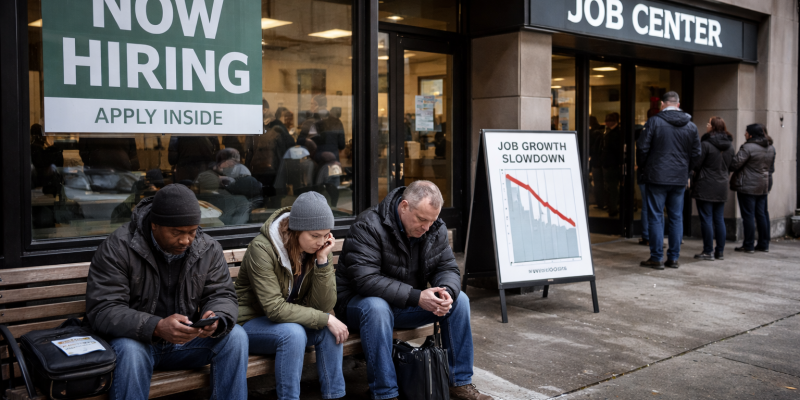
By US job growth slowed further in December, underscoring signs that the labour market remains stuck in a prolonged period of weak hiring despite steady economic growth.
Nonfarm payrolls increased by 50,000 last month, well below economists’ expectations for a 73,000 gain, according to data released by the Bureau of Labor Statistics on Friday.
The unemployment rate fell to 4.4%, slightly better than forecasts for 4.5%.
The figures reinforced the view among policymakers that the economy is experiencing a “no hire, no fire” phase, with companies reluctant to add workers but also unwilling to cut jobs aggressively.
Job gains narrow to a few sectors
Hiring continued to be concentrated in a narrow set of industries.
Employment rose in food services and drinking places, health care, and social assistance, while retail trade shed jobs, reflecting ongoing pressure on consumer-facing businesses.
For 2025 as a whole, payroll employment rose by 584,000, averaging about 49,000 jobs a month.
That marked a sharp slowdown from 2024, when payrolls grew by about 2 million, highlighting the loss of momentum that has defined the past year.
The moderation in job growth has coincided with strong gains in economic output and productivity.
Gross domestic product and worker productivity surged in the third quarter, driven in part by heavy investment linked to artificial intelligence, allowing companies to grow without expanding their workforce.
Unemployment falls, but long-term joblessness rises
While the headline unemployment rate declined, other measures pointed to lingering weakness.
The number of people unemployed for less than five weeks edged down to 2.3 million in December.
The number of long-term unemployed, defined as those out of work for 27 weeks or more, was little changed at 1.9 million but stood nearly 400,000 higher than a year earlier.
Long-term unemployed workers accounted for 26% of total unemployment, suggesting that re-entry into the labour market remains difficult for many.
The BLS also revised November’s unemployment rate down to 4.5% from 4.6% following annual updates to household survey data.
Data revisions add uncertainty
Questions around the true strength of job creation have intensified after the BLS estimated that about 911,000 fewer jobs were created in the 12 months through March 2025 than previously reported.
The agency will publish its full benchmark revision with January’s employment report.
The discrepancy has been linked to the so-called birth-death model, which estimates job creation from new businesses.
The BLS has said it will begin incorporating more current data into the model starting in January.
Markets rise as investors weigh risks
US equity futures rose after the report, with S&P 500 futures up 0.3%, Nasdaq 100 futures gaining 0.4%, and Dow futures adding about 132 points.
Investors also remained focused on the possibility of a US Supreme Court ruling on the legality of President Donald Trump’s tariffs, which could affect trade policy and government finances.
The labour market slowdown has been partly blamed on Trump’s trade and immigration policies, which economists say have weighed on both labour demand and supply.
However, officials note that the cooling trend began well before last year.
January Fed rate cut unlikely?
The Federal Reserve cut interest rates by a quarter point in December to a 3.50%–3.75% range, but has signalled it is likely to pause further cuts for now.
Today’s drop in the US unemployment rate means there’s almost no chance of a cut to interest rates this month, Seema Shah, chief global strategist at Principal Asset Management, said.
The prospect of a January Fed rate cut has all but vanished following the unexpected drop in the unemployment rate. It is now difficult to argue that the labour market is collapsing and in urgent need of monetary support.
“However, the picture remains far from clear: payroll growth undershot expectations, and downward revisions to prior months have pushed the three-month moving average into negative territory. While a tighter labor supply may explain part of the dynamic, sustained job losses hardly inspire confidence,” she added.
The US economy likely requires additional support from the Fed — just not immediately.
The post US jobs add 50,000 in December, miss estimates as unemployment dips to 4.4% appeared first on Invezz